India Just Launched Its Net Zero Portal. What Does It Actually Change for Companies?
The Net Zero Portal and NAPCC Dashboard, explained: what they do, what stays voluntary, and why the data behind each pledge now matters more
Reading Time
5 min
Article Sections
6
Share Links
3
On This Page
Article Section
Introduction
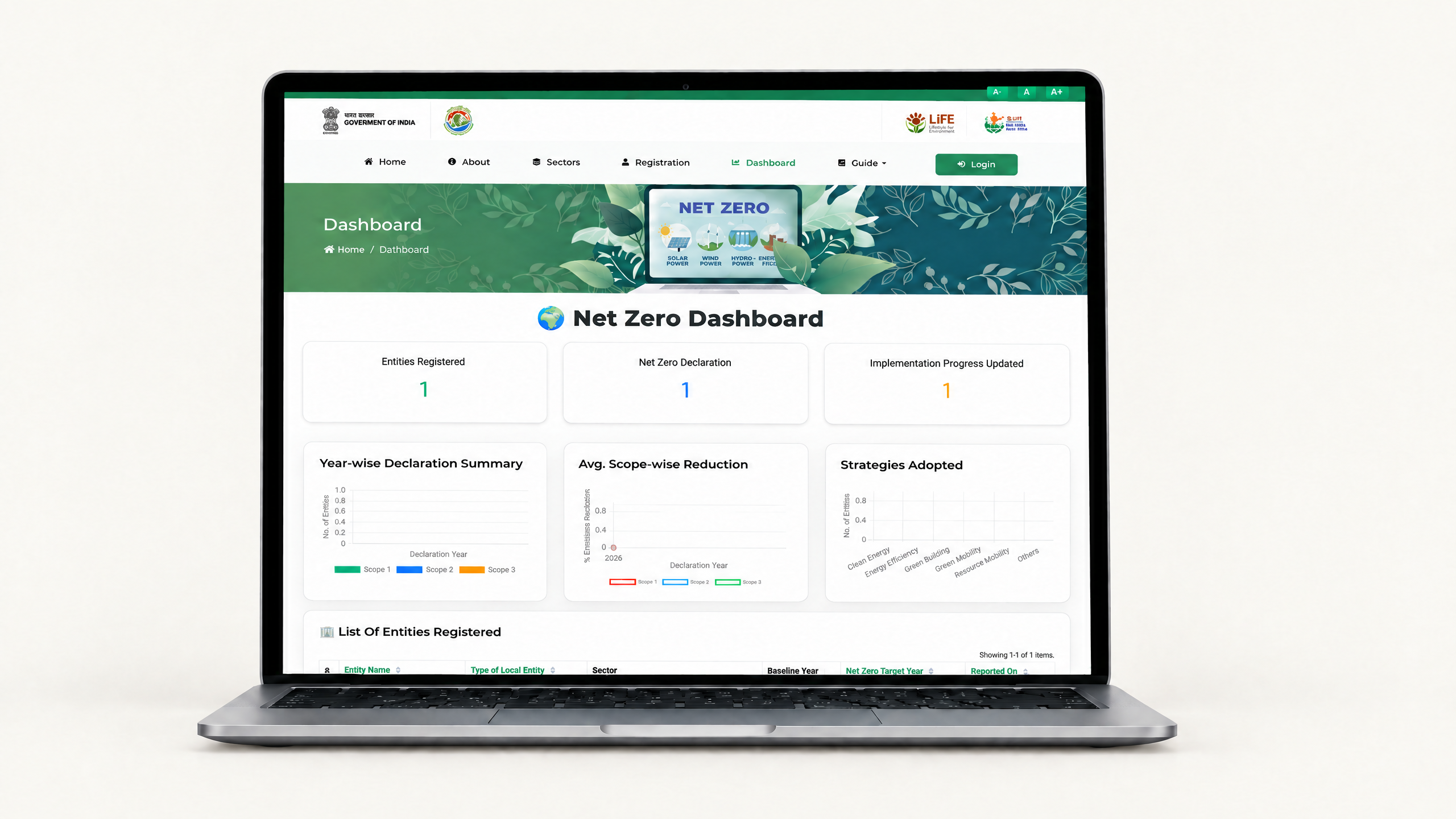
India launched its Net Zero Portal and the National Action Plan on Climate Change (NAPCC) Dashboard in Mumbai on 16 September 2026. Through the portal, companies and other organisations can volunteer to register, disclose their greenhouse-gas emissions, declare Net Zero targets and report their progress each year, all on one government platform.
Most coverage has stopped at that announcement. The portal is only the start of the story.
The bigger story is what happens once corporate Net Zero pledges are easier to find, read side by side and follow over time. Those pledges are part of how India gets to its 2070 Net Zero target.
A pledge made in an annual report is easy to forget. A pledge on a national public register sits next to the next year's update, and the gap between commitment and evidence gets harder to ignore.
Article Section
What India Actually Launched on 16 September 2026
On World Ozone Day, Kirti Vardhan Singh, Union Minister of State for Environment, Forest and Climate Change, launched two separate tools in Mumbai.
Net Zero Portal: a public record of voluntary Net Zero commitments made by organisations, available at netzeroindia.moef.gov.in.
NAPCC Dashboard: a government monitoring tool that brings together implementation progress on the National Missions under the National Action Plan on Climate Change, available at napccindia.moef.gov.in.
In short, the portal covers what organisations commit to, and the dashboard covers what the government is delivering.
Article Section
India's Net Zero Portal: What Can Companies Actually Do?
What Is India's Net Zero Portal?
It is a government platform where organisations can voluntarily register, disclose their emissions, declare a Net Zero target and update their progress every year. According to the Ministry, it creates "a consolidated repository of voluntary Net Zero actions in the country," and participants' disclosures are publicly accessible. The portal says it will provide standardised reporting guidelines, including clarity on emission scopes, and aims to align with India's national climate goals and frameworks such as the UNFCCC, the Science Based Targets initiative (SBTi) and the GHG Protocol.
Portal Features at a Glance
Registration: Voluntary and one-time; open to organisations, industries and government bodies. Emissions disclosure: Participants report their greenhouse-gas emissions. Net Zero target: Participants declare a target; the Ministry acknowledges successful declarations. Annual update: Participants report progress every year. Transition pathway: Participants set out their route to the target: clean energy, energy efficiency, technology and, where applicable, carbon removals. Scope 1: Direct emissions; reporting encouraged. Scope 2: Emissions from purchased energy; reporting encouraged. Scope 3: Value-chain emissions; reporting voluntary.
Article Section
What Is Still Voluntary?
The launch has already produced some loose readings, so this part matters most.
Registration is voluntary. No company has to join.
Scope 3 is voluntary. The government encourages Scope 1 and Scope 2 reporting and leaves Scope 3 optional.
An acknowledgement is not a certification. When the Ministry acknowledges a declared target, that does not verify the target, assure the data or signal that the target is achievable.
No new compliance obligation. The portal does not change what companies must already report under existing rules, such as SEBI's Business Responsibility and Sustainability Report (BRSR) or the Carbon Credit Trading Scheme (CCTS).
The portal doesn't make Net Zero mandatory. It makes Net Zero commitments visible, and once they are visible, people start checking them.
Article Section
The Bottom Line
The Net Zero Portal does not force anyone to decarbonise, and it does not certify anyone's target. It creates public infrastructure for voluntary climate commitments. How much that infrastructure matters will depend on how many organisations join, how good the data is, how often it is updated and how the information connects with the rest of India's climate policy.
The portal describes its own aim as "fostering transparency, credibility, and accountability." Whether it gets there depends less on the pledges and more on the data behind them. The Net Zero target is where a company's disclosure starts; the evidence is what gives it credibility.
Article Section
Frequently Asked Questions
What is India's Net Zero Portal?
A MoEFCC platform, launched on 16 September 2026, where organisations can voluntarily register, disclose their emissions, declare Net Zero targets and update their progress every year.
Is registration on the Net Zero Portal mandatory?
No. Both registration and disclosure on the portal are voluntary.
Who can register on the Net Zero Portal?
Organisations, industries and government bodies can register voluntarily at netzeroindia.moef.gov.in.
What emissions can companies disclose?
Scope 1 and Scope 2 reporting is encouraged. Scope 3 can be reported voluntarily.
Does the Net Zero Portal require Scope 3 reporting?
No. Scope 3 reporting is voluntary, although the portal says its reporting guidance will eventually cover Scope 3.
Does the portal certify Net Zero targets?
No. The Ministry acknowledges successful declarations. That acknowledgement is not a certification, assurance or verification.
What is the NAPCC Dashboard?
A MoEFCC platform that tracks implementation progress on India's nine National Missions under the National Action Plan on Climate Change, across 28 states and 8 union territories.
Who launched the Net Zero Portal and when?
Kirti Vardhan Singh, Union Minister of State for Environment, Forest and Climate Change, launched it in Mumbai on 16 September 2026, World Ozone Day.
Next Step
Ready to turn ESG complexity into strategic advantage?
Talk to ESG Astraa about disclosures, climate strategy, governance controls, and execution support for your team.