GRI vs ESG
Is GRI the Same as Sustainability Reporting?

Reading Time
5 min
Article Sections
6
Share Links
3
On This Page
Article Section
Introduction
A job title says ESG, a report says sustainability, and a customer asks for a GRI report. Many teams use the three as if they meant the same thing, and they do not. Procurement teams and assurance providers meet the same confusion when they compare reports.
The mix-up matters more now that companies handle GRI, ISSB, ESRS and BRSR at the same time. Using the wrong term can mean sending the wrong report to the wrong reader.
This GRI vs ESG guide explains what ESG is, what sustainability reporting is, where GRI fits, and how GRI sits beside other frameworks.
Article Section
What ESG Is and Where GRI Sits?
ESG stands for environmental, social and governance. The term was coined in a 2004 report by the UN Global Compact called Who Cares Wins, which was written for financial markets and asked them to consider these three areas in their work.
Today ESG works as a lens. Companies, investors and other groups use it to look at how an organisation handles environmental, social and governance issues. Because ESG is a concept, it has no reporting requirements of its own. It tells you which area is being discussed, but not how to measure or report it.
Sustainability reporting is the practice of publicly reporting on those issues. GRI, the Global Reporting Initiative, publishes a set of Standards for doing so, and says they can be used to create sustainability, non-financial or integrated ESG reports.
A simple way to keep the three apart: ESG is the subject, and GRI is one rulebook for reporting on it.
Article Section
GRI vs ESG Explained: Three Different Things
ESG: the concept
ESG groups issues into three areas. Investors, companies and other groups use it to describe how an organisation manages environmental, social and governance matters. It has no fixed structure or required content, so two ESG reports can look completely different.
Sustainability reporting: the practice
GRI 1 defines sustainability reporting as a process. It starts with an organisation determining its material topics based on its most significant impacts and ends with publicly reporting information about those impacts. The process can follow different frameworks.
GRI: the standards
GRI is a modular system of Universal, Sector and Topic Standards. They set requirements and reporting principles, and they focus on an organisation's impacts on the economy, environment and people. GRI 1 also states that the Standards set no benchmarks for good or bad performance, so GRI content is not a rating or a score.
Does GRI cover ESG issues?
Yes. Topic Standards cover subjects such as water and effluents, anti-corruption and occupational health and safety, and GRI 2 asks every reporter for governance disclosures. GRI reaches ESG topics through impacts, and an organisation reports on the topics it determines to be material.
GRI beside ISSB, ESRS and BRSR
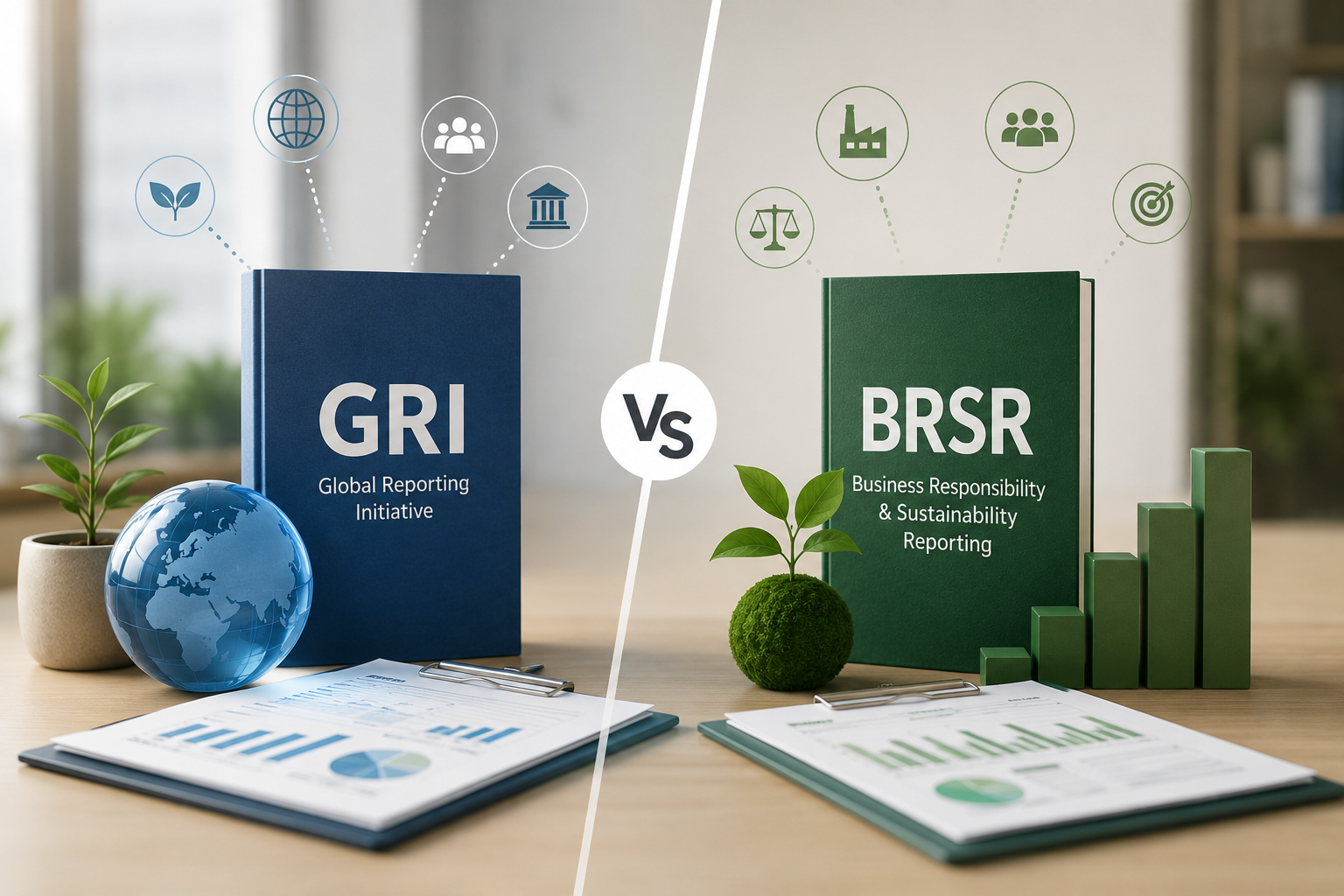
GRI asks about impacts. IFRS S1 from the ISSB asks for information on sustainability-related risks and opportunities that is useful to users of financial reports who decide whether to provide resources to a company. ESRS are the reporting standards under the EU's CSRD. BRSR is the format SEBI requires from India's top 1,000 listed companies. They serve different readers, so one report may not fit all.
Article Section
Using the Terms Correctly
Ask which question is being asked
An investor rating, a regulatory filing and a stakeholder report ask different questions, so start with the reader.
Name the framework
State which framework the report uses and, for GRI, whether it is in accordance with or with reference to the Standards.
Do not treat GRI as a score
GRI reporting shows what an organisation reports and how it manages its impacts. It does not rate performance.
Ask what the reader expects
Customers, investors and regulators may each name a specific framework, so confirm this before starting.
Use one label per document
Pick one term, such as sustainability report, and use it consistently, so readers do not assume a different framework sits behind it.
Check definitions before reusing data
Frameworks define terms and scope differently, so check each one's own definitions before sharing data across reports.
Article Section
Conclusion
ESG is the subject, sustainability reporting is the practice and GRI is one set of standards for that practice. Keeping the three apart avoids sending the wrong report to the wrong reader. Each term answers a different question: what to look at, how to report it, and which rules to follow.
Before the next report, write down which framework it uses and which reader it serves, and use those words in the report.
Article Section
Frequently Asked Questions
Is GRI the same as ESG?
No, ESG is a broad concept covering environmental, social and governance issues, while GRI is a specific set of reporting standards.
What is the difference between GRI and ESG?
ESG describes the subject area, whereas GRI provides requirements and reporting principles for reporting on an organisation's impacts.
Does GRI cover ESG issues?
Yes, GRI Topic Standards and GRI 2 cover environmental, social and governance matters, and an organisation reports on the topics it finds material.
Is GRI the same as sustainability reporting?
No, sustainability reporting is the wider practice of publicly reporting on impacts, and GRI is one set of standards that can be used for it.
Can a company use GRI alongside ISSB, ESRS or BRSR?
Yes, a company can use more than one framework, and GRI 1 allows selected GRI Standards to be used for specific purposes such as a reporting regulation.
Keep Reading
Related Blogs


Next Step
Ready to turn ESG complexity into strategic advantage?
Talk to ESG Astraa about disclosures, climate strategy, governance controls, and execution support for your team.