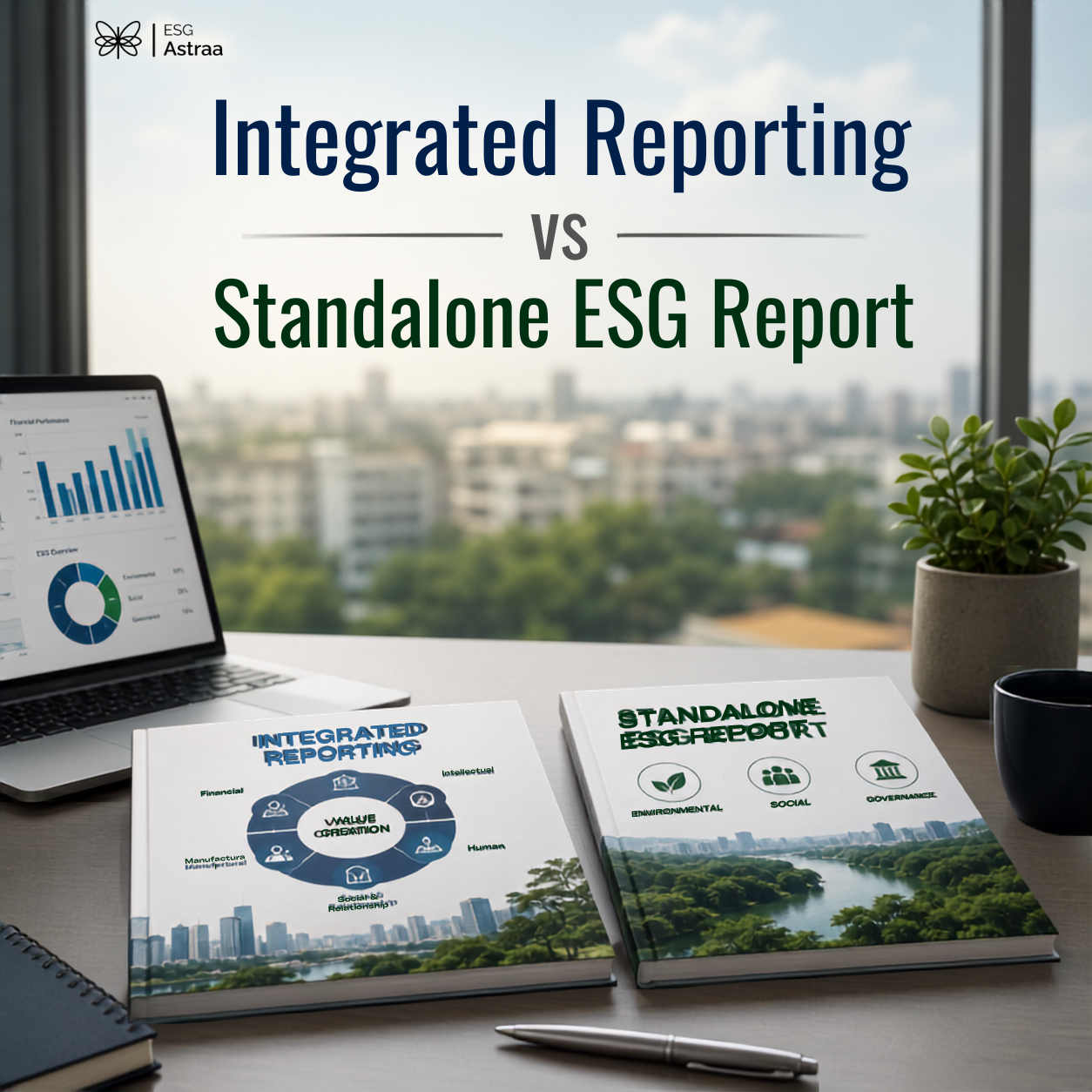
Integrated Reporting vs Standalone ESG Report
What Format Works Best for Indian Listed Companies
Reading Time
4 min
Article Sections
6
Share Links
3
On This Page
Article Section
Introduction
Every year, Indian listed companies face the same unresolved question when annual report season arrives, should ESG performance sit inside the integrated report alongside financial results, or does it deserve a standalone document of its own. There is no regulatory answer, and both formats now have credible adopters among large Indian companies.
BRSR has matured to a point where most large caps have several years of structured ESG data behind them, giving companies genuine flexibility in how they present it. At the same time, investors are reading ESG disclosures more closely than before, and the format a company chooses signals something about how central sustainability is to its strategy.
The better format is not a matter of best practice consensus, it is a strategic choice that should follow a company's investor base, sector exposure, and reporting maturity rather than industry convention.
Article Section
How the Two Formats Differ?
Integrated reporting traces back to the International Integrated Reporting Council's framework, now part of the IFRS Foundation, which asks companies to explain how financial, human, social, and natural capital together create value over time. In this format, ESG metrics sit inside the same document as financial statements, framed around the company's value creation story rather than presented as a separate compliance exercise.
Standalone ESG reports, often built on GRI standards or SEBI's BRSR structure, take the opposite approach, treating sustainability disclosure as a document in its own right, with room for granular data across environment, social, and governance parameters that would clutter an integrated report's narrative flow.
Adoption in India reflects this split. Large diversified conglomerates with sophisticated investor relations functions have gravitated toward integrated reporting, while companies driven primarily by regulatory compliance or sector-specific ESG scrutiny tend to keep a standalone BRSR-aligned report, sometimes alongside a lighter integrated summary.
Article Section
What the Analysis Reveals?
What Does Integrated Reporting Do Well?
Integrated reporting forces a company to connect ESG performance directly to financial value creation, which resonates with mainstream investors who read the annual report as their primary source of truth. It also signals that sustainability is embedded in strategy rather than treated as a parallel compliance stream.
What Do Standalone ESG Reports Do Well?
Standalone reports allow far greater disclosure depth, useful for specialist ESG investors, rating agencies, and NGOs who want granular metrics rather than a strategic narrative. They also give sustainability teams more editorial control over how nuanced or sensitive issues are presented, without competing for space with financial disclosures.
Where Do Both Formats Fall Short?
Neither format solves the underlying problems of data consistency and assurance. Companies with weak ESG data systems produce unconvincing reports regardless of format, and comparability across companies remains difficult because BRSR permits enough flexibility in presentation that two integrated reports or two standalone reports are rarely built the same way.
Article Section
What This Means for Companies and Boards?
How Should Companies Decide?
The decision should follow investor base and sector, not convention. Companies with a large institutional and ESG-focused investor base benefit from integrated reporting's narrative strength, while companies in sectors under heavier regulatory or civil society scrutiny may need the disclosure depth only a standalone report can offer.
What Are Leading Indian Companies Doing?
A growing number of large-cap Indian companies now publish both, a concise ESG narrative within the integrated report and a detailed standalone BRSR-aligned report for readers who want the underlying data. This dual approach costs more to produce but avoids forcing a tradeoff between narrative and depth.
What Should Boards Ask Before Choosing a Format?
Boards should ask who actually reads each report, whether the company's ESG data systems can support the disclosure depth being promised, and whether the chosen format will still work as reporting requirements tighten over the next few years.
Article Section
Conclusion
Format choice should follow strategy, not convention. Companies that treat this as a genuine decision, rather than defaulting to what peers do, produce reports that better serve the investors and stakeholders who actually read them.
As BRSR requirements mature and assurance expectations rise, expect growing pressure toward integrated formats for large caps, with standalone reports increasingly reserved for companies that need disclosure depth beyond what an integrated narrative can carry.
Article Section
Frequently Asked Questions
What is the core difference between integrated reporting and a standalone ESG report?
Integrated reporting embeds ESG within the financial annual report as part of a value creation narrative, while a standalone ESG report presents sustainability data as an independent document.
Does SEBI require Indian listed companies to use one format over the other?
No, SEBI's BRSR framework mandates specific ESG disclosures but does not prescribe whether they appear within an integrated report or a standalone document.
Which format is more credible to investors?
Credibility depends more on data quality and assurance than on format, though mainstream institutional investors often engage more directly with integrated reports.
Can a company use both formats?
Yes, many large Indian companies now publish a concise ESG narrative within the integrated report alongside a more detailed standalone BRSR-aligned report.
How does assurance differ between the two formats?
Assurance requirements are generally tied to the underlying BRSR data itself rather than the reporting format, so both integrated and standalone reports need equivalent verification.
Keep Reading
Related Blogs
All Industries
ESG and the Indian SME
Why Small Suppliers Are Suddenly Under Pressure From Their Largest Clients
Read more
All Industries
Five ESG Metrics Every Investor Pitch in India Should Now Include
Most Still Don't Know
Read more
All Industries
Carbon Credits vs Carbon Offsets
Understanding the Difference Before Making Climate Claims
Read moreNext Step
Ready to turn ESG complexity into strategic advantage?
Talk to ESG Astraa about disclosures, climate strategy, governance controls, and execution support for your team.