Carbon Credits vs Carbon Offsets
Understanding the Difference Before Making Climate Claims
Reading Time
5 min
Article Sections
6
Share Links
3
On This Page
Article Section
Why the Distinction Matters?
Carbon credits and carbon offsets are used interchangeably in boardrooms, sustainability reports, and marketing material, but they are not the same thing. A sustainability manager buying credits, a CFO approving an offset programme, a communications team drafting a net-zero claim; most have moved through these decisions without pausing on the distinction.
It matters now. Climate commitments are being scrutinised more carefully than ever, greenwashing liability is rising, and domestic carbon markets are taking shape across major economies as regulators begin to define what climate claims can and cannot say. Getting the language right is no longer a semantic exercise; it is the first step to getting the strategy right.
For business leaders, the distinction affects climate strategy, stakeholder credibility, and increasingly, regulatory compliance. This article explains what each term actually means, where offsets fit in a credible climate strategy, and what to consider before an organisation buys carbon credits.
Article Section
Carbon Credits: The Unit of Account
A carbon credit represents one tonne of carbon dioxide equivalent either reduced or removed from the atmosphere. That is the unit of measurement, and it does not change regardless of how the credit is used or who holds it. Credits are created through verified projects: a wind farm displacing coal-fired electricity, a reforestation initiative sequestering carbon over decades, a landfill capturing and destroying methane, or an energy efficiency programme that measurably reduces consumption. Each, when verified, generates credits proportional to the emissions prevented or removed.
Verification is what gives a credit its credibility. Standards bodies assess whether the claimed reductions are real, measurable, and additional, meaning they would not have occurred without the project. Certified credits are registered and tracked so they can be traded without being double-counted.
A carbon credit is a verified, tradable unit. It exists whether or not anyone ever uses it to compensate for their own emissions.
Article Section
Carbon Offsets: The Action, Not the Instrument
Offsetting is the decision to retire credits, not the act of buying them
Offsetting is what happens when an organisation purchases and retires carbon credits to compensate for its own emissions. The credit is the tool. The offset is the decision to use it. The credits do not remain in circulation once retired; retirement ensures they cannot be used again by another buyer, which is what makes the offset claim valid.
A practical example shows where the offset actually happens
A mid-sized manufacturing company measures its annual emissions at 10,000 tonnes of CO2 equivalent. After investing in efficiency improvements and switching part of its energy supply to renewables, it reduces its footprint to 8,000 tonnes. The remaining 2,000 tonnes, tied to processes it cannot yet decarbonise, are addressed by purchasing and retiring 2,000 verified carbon credits. That retirement is the offset.
The distinction matters most in how a claim is communicated
Saying 'we purchased carbon credits' is a procurement decision. Saying 'we offset our emissions' is a climate claim. The second requires the first, but buying credits alone does not constitute an offset; the retirement does. Offsetting is an action. Carbon credits are what make that action possible.
Article Section
Where Offsets Fit in a Corporate Climate Strategy?
Offsets sit at the end of the hierarchy, not the beginning
The sequence that investors, rating agencies, large customers, and regulators increasingly expect runs as follows: measure emissions accurately, reduce at source, improve operational efficiency, transition to cleaner energy, and then offset what genuinely remains.
The credibility threshold for offset use is shifting
Scrutiny around terms like carbon neutral and net zero has intensified considerably. Regulators in the EU and the UK are already moving to restrict unsubstantiated climate claims in advertising and corporate reporting, and rating agencies have become more probing about the quality of credits used and the extent of actual reductions behind them. High-quality offsets applied to unavoidable residual emissions are widely accepted; offsets used as a substitute for reducing emissions are not, and claiming otherwise carries growing legal and reputational risk.
India's regulatory landscape is making this a compliance issue, not just a strategy choice
India's net-zero target of 2070 and updated Nationally Determined Contributions signal a trajectory that will touch corporate operations well before 2070. The Carbon Credit Trading Scheme (CCTS), notified in 2023, is establishing a domestic carbon market that will create compliance obligations for energy-intensive sectors. SEBI's BRSR framework has made structured climate disclosure mandatory for large listed companies, and the scope is widening, while global customers increasingly require carbon transparency from Indian suppliers as part of procurement criteria.
Article Section
Conclusion
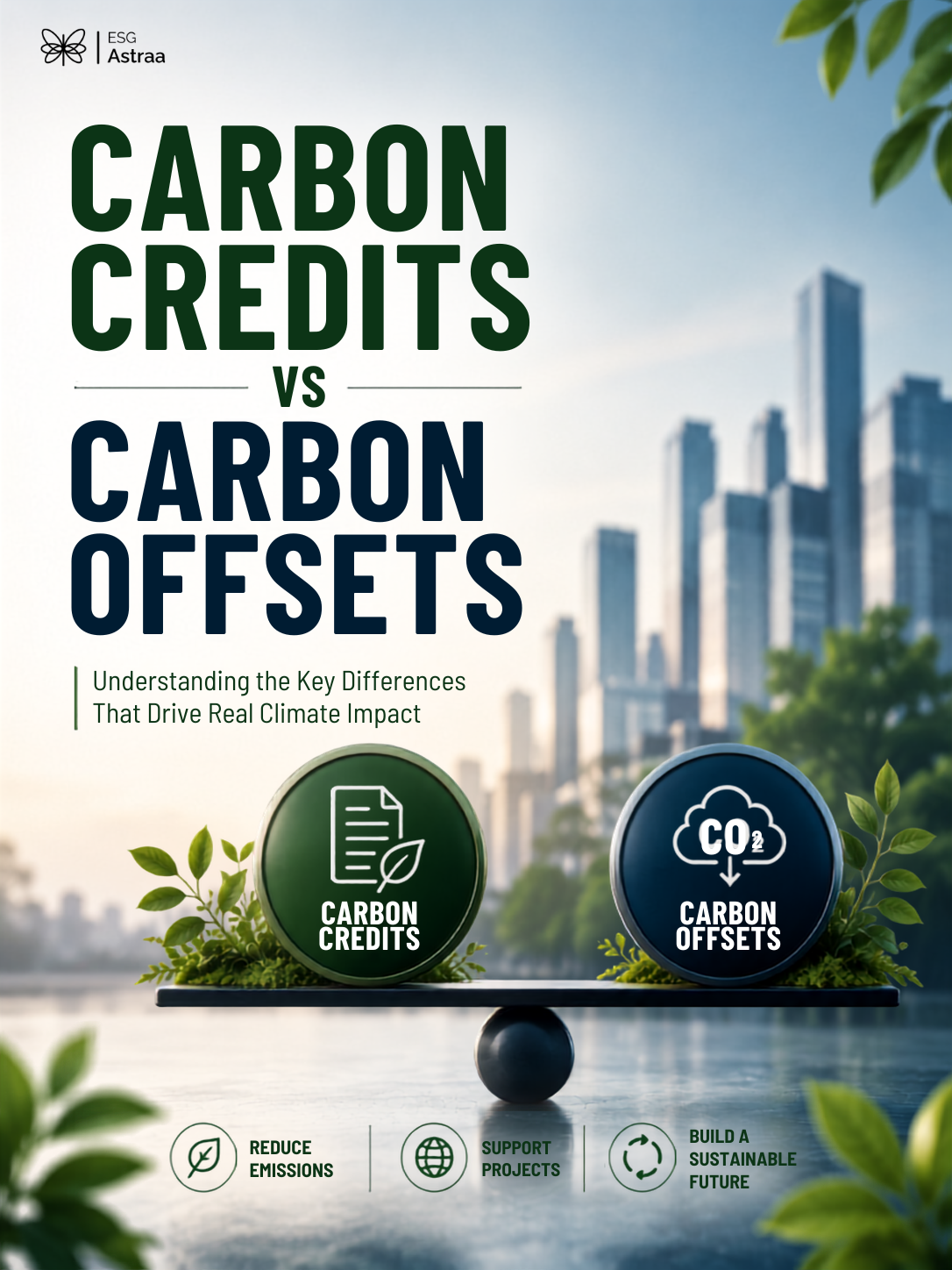
Carbon credits are the unit. Carbon offsets are the outcome when those units are used to compensate for emissions. The two are related, but they are not interchangeable, and the distinction carries real consequences for how climate commitments are built, communicated, and defended. The most credible climate strategies treat offsets as the final layer of a genuine reduction effort, applied to what genuinely cannot yet be eliminated.
As carbon markets mature, the standards applied to these claims will only become more exacting. For business leaders, the relevant question is no longer whether carbon markets matter, but whether their organisation understands them well enough to use them with confidence.
Article Section
Frequently Asked Questions
What is the difference between carbon credits and carbon offsets?
A carbon credit is a verified, tradable unit representing one tonne of CO2 reduced or removed, while a carbon offset is the act of retiring those credits to compensate for your own emissions.
How are carbon credits created?
Carbon credits are generated through verified projects such as renewable energy, reforestation, methane capture, or energy efficiency programmes, assessed by a standards body to confirm the reductions are real, measurable, and additional.
Does buying carbon credits mean you have offset your emissions?
Not automatically: buying credits is a procurement decision, and offsetting only happens when those credits are retired so no other buyer can claim them.
Where do carbon offsets fit in a corporate climate strategy?
Offsets belong at the end of the hierarchy, after a company has measured, reduced, and improved efficiency, and are meant for residual emissions that cannot yet be eliminated rather than a substitute for reducing emissions at source.
What is the Carbon Credit Trading Scheme (CCTS) in India?
The CCTS, notified in 2023, is India's first structured domestic carbon market designed to scale across energy-intensive sectors, moving carbon pricing from a voluntary consideration to a compliance obligation.
Next Step
Ready to turn ESG complexity into strategic advantage?
Talk to ESG Astraa about disclosures, climate strategy, governance controls, and execution support for your team.