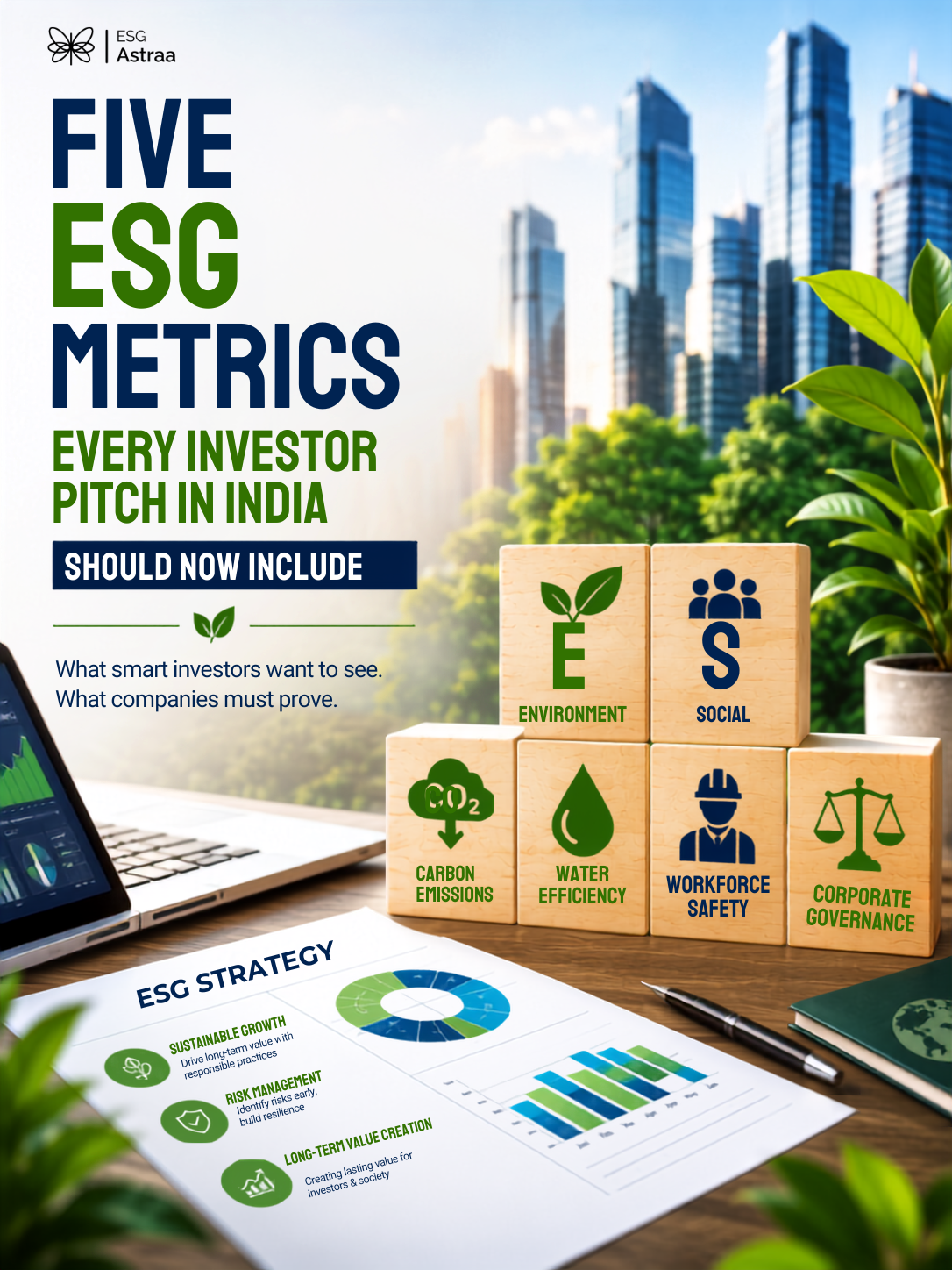
Five ESG Metrics Every Investor Pitch in India Should Now Include
Most Still Don't Know
Reading Time
6 min
Article Sections
6
Share Links
3
On This Page
Article Section
Introduction
A strong Indian company pitch: credible management, solid financials, and then the ESG section: a paragraph about values, a mention of a CSR programme, and a reference to being BRSR compliant. The investor moves on knowing the due diligence conversation is going to surface gaps the company is not prepared for.
A growing share of institutional capital flowing into Indian markets is subject to ESG mandates, meaning fund managers need to demonstrate ESG performance to their own LPs. When a portfolio company cannot provide verifiable ESG data, the fund manager has a problem, and that problem affects valuation, deal structure, and in some cases the investment decision itself.
This article identifies the five ESG metrics that institutional investors in India are now consistently asking for, why each one matters beyond compliance, and why most pitches still do not include them.
Article Section
Why the ESG Bar in Indian Capital Markets Has Shifted?
Foreign institutional investors operating under SFDR, domestic mutual funds incorporating ESG screens, and PE and VC funds with LP-level ESG commitments are all now standard participants in Indian capital markets. Each has its own due diligence checklist, and increasingly, these checklists ask for the same categories of data.
The mandatory BRSR disclosure framework for the top 1,000 listed companies has created a minimum data floor, but investor due diligence asks questions the BRSR format does not require. A company can be fully BRSR compliant and still be unable to answer the specific, quantified ESG questions an institutional investor needs for their own reporting.
Companies that treat BRSR compliance as the finish line are prepared for the regulator's questions but not for the investor's. The gap is no longer theoretical; it is showing up in deal timelines, valuation discussions, and post-investment engagement requests.
Article Section
The Five Metrics Investors Are Looking For
Scope 1 and 2 emissions with a disclosed calculation methodology
A number without a methodology is not usable in an investor's ESG reporting. Investors need the absolute figure, the baseline year, the emission factors used, and whether the data has been externally verified. A verified Scope 1 and 2 figure with a clean methodology disclosure is the single metric most commonly missing from Indian company pitches despite being the most straightforward to produce.
Energy intensity with a year-on-year trend
Absolute energy consumption tells investors how much energy the business uses. Energy intensity normalised against revenue or output tells them whether the business is becoming more or less efficient as it scales. The trend matters more than the absolute figure; investors want to see the direction, not just the snapshot.
Water withdrawal and stress-adjusted context
Water risk is material for a wide range of Indian sectors including textiles, food and beverage, chemicals, and agriculture-linked businesses. Investors subject to TCFD or TNFD frameworks need to know not just how much water a company withdraws but whether the facilities sit in water-stressed basins. A company that can provide facility-level water data contextualised against WRI Aqueduct or similar stress mapping is significantly ahead of those providing only an aggregate withdrawal figure.
Board-level ESG governance disclosure
Investors need to demonstrate to their own LPs that portfolio companies have board-level accountability for ESG, not just a sustainability team filing BRSR reports. The specific question is whether ESG performance is a standing board agenda item, and whether any director has defined ESG responsibilities. A yes with supporting evidence is a differentiator in due diligence; a blank is a flag.
Workforce safety data with LTIFR
The Lost Time Injury Frequency Rate is a standard safety metric that most institutional ESG frameworks require for any company with significant operational or manufacturing exposure. Companies that track LTIFR and can show a multi-year trend are demonstrating that worker safety is operationally managed, not just reported. Companies that cannot provide this figure when asked are signalling a material gap in how they manage one of the most legally and reputationally exposed areas of ESG.
Article Section
What Including These Metrics Actually Signals?
It signals data infrastructure, not just intent
A company that can produce verified emissions data with a disclosed methodology, facility-level water data, and a multi-year LTIFR trend is demonstrating that ESG is embedded in operational management. That infrastructure signal is what sophisticated investors are reading, not the ESG narrative around it.
It compresses the due diligence timeline
Investors who receive an ESG data package that matches what they need for their own reporting spend less time in follow-up requests and more time advancing the deal. Companies that cannot provide the data upfront add weeks to the due diligence process, which has real cost in competitive deal situations.
It positions the company for higher-quality capital
ESG data quality increasingly correlates with access to longer-duration, lower-cost institutional capital. Companies able to demonstrate ESG operational maturity are eligible for a broader set of investors and, in some cases, favourable deal structures tied to ESG performance milestones.
Article Section
Conclusion
The ESG section of an Indian investor pitch is no longer a place for narrative. It is an evidence section, and the investors sitting across the table have a checklist. The five metrics identified here are not advanced or complex; they are the floor of what institutional ESG due diligence now requires.
Companies that build these metrics into their standard investor materials before the due diligence request arrives will compress deal timelines, avoid late-stage valuation adjustments, and access a broader set of institutional capital. Companies that continue to lead with intent over evidence will keep discovering the gap at the worst possible moment.
Article Section
Frequently Asked Questions
Why are institutional investors in India now asking for specific ESG metrics in pitches?
Institutional investors are subject to their own LP-level ESG mandates and need verifiable portfolio company data to meet those obligations, making generic ESG narratives insufficient for due diligence.
What is the difference between BRSR compliance and ESG investor readiness?
BRSR compliance satisfies the regulator's disclosure requirements, while ESG investor readiness means having the specific, verified, and methodology-backed data that institutional investors need for their own ESG reporting.
What is LTIFR and why do investors use it as an ESG metric?
Lost Time Injury Frequency Rate measures the number of lost-time injuries per million hours worked, and investors use it as a standard proxy for how operationally managed a company's worker safety practices are.
How should a company present Scope 1 and 2 emissions data in an investor pitch?
Present the absolute figure alongside the baseline year, the emission factors and methodology used, the boundary of operations covered, and whether the data has received any form of external verification.
What does board-level ESG governance disclosure mean in practice?
It means disclosing whether ESG performance is a standing board agenda item and whether any named director holds defined ESG accountability, supported by evidence such as board minutes or terms of reference.
Next Step
Ready to turn ESG complexity into strategic advantage?
Talk to ESG Astraa about disclosures, climate strategy, governance controls, and execution support for your team.