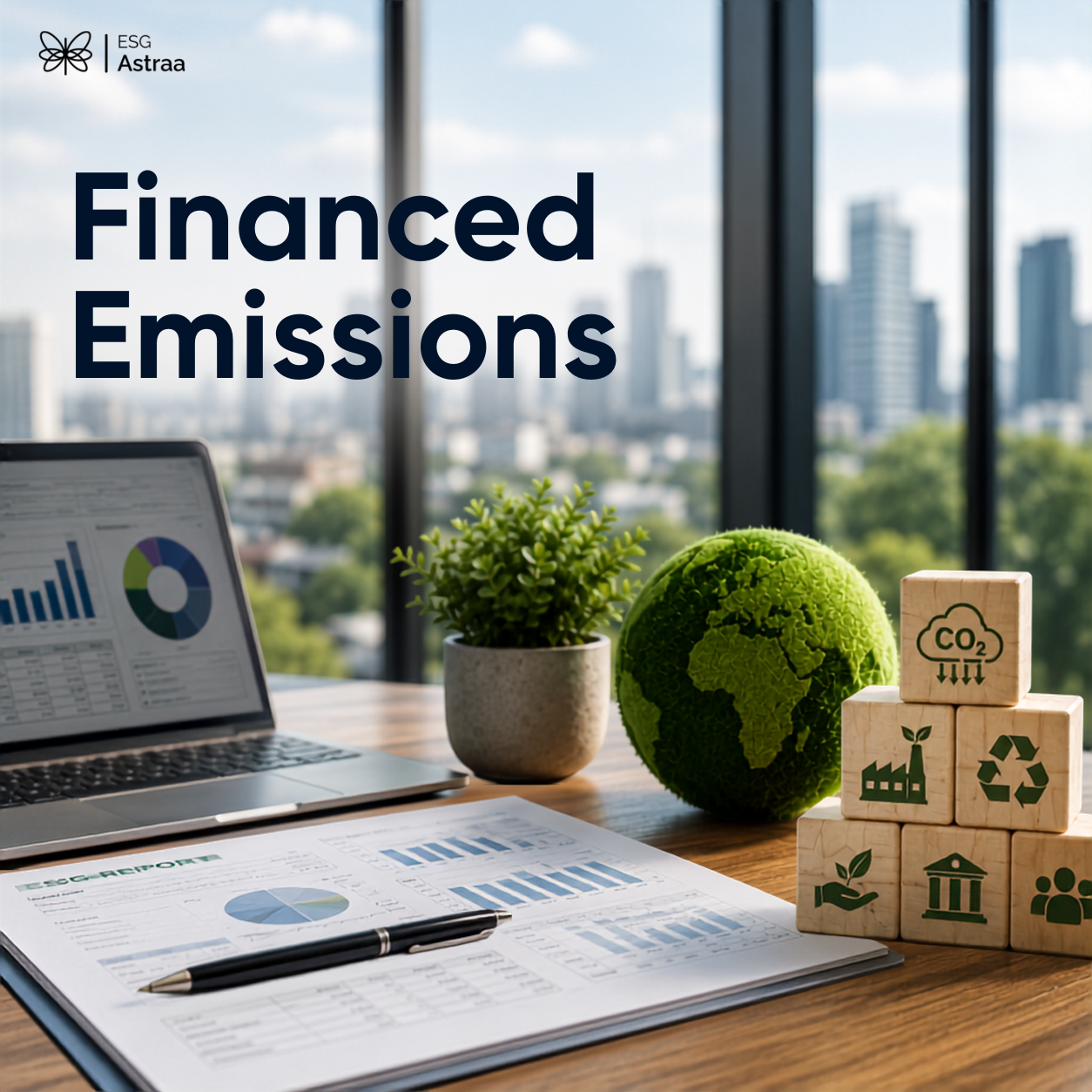
Financed Emissions
The ESG Calculation That Is Reshaping India's Banking Sector
Reading Time
5 min
Article Sections
6
Share Links
3
On This Page
Article Section
Introduction
A bank's own offices, branches, and data centres typically account for a tiny fraction of its total carbon footprint. The emissions that matter sit several steps removed, embedded in the factories, power plants, and vehicles its loans and investments finance. This category, known as financed emissions, is now the metric Indian banks cannot avoid.
Pressure is building from multiple directions at once. The Reserve Bank of India has moved climate risk disclosure from an optional gesture to an expected discipline for large lenders, global investors are asking Indian banks to report portfolio level carbon exposure using the PCAF methodology, and rating agencies increasingly factor financed emissions into their assessment of transition risk.
Financed emissions accounting is shifting from a disclosure formality into a core credit risk and capital allocation tool, and the banks that treat it that way will out compete those that still see it as a compliance line item.
Article Section
Why Financed Emissions Have Moved to Center Stage?
Financed emissions sit under Scope 3, Category 15 of the GHG Protocol, the category covering a company's investments and lending. For banks, this is not an abstract accounting category, it is usually the largest single component of their total carbon footprint, often several hundred times larger than their operational emissions according to global benchmarking studies. The Partnership for Carbon Accounting Financials, known as PCAF, has become the reference methodology worldwide, and Indian banks have started adopting it to attribute a proportional share of each borrower's emissions to the loan or investment that financed them.
Regulatory pressure has accelerated adoption. The RBI's climate risk disclosure framework asks scheduled commercial banks to disclose material climate related financial risks, and financed emissions sit at the centre of that assessment because they determine how exposed a bank's balance sheet is to carbon intensive, transition vulnerable sectors. SEBI's BRSR framework has pushed listed companies toward more granular emissions disclosure, which in turn improves the raw data banks need to calculate financed emissions with any precision.
Global banks have already restructured lending books around this metric, setting sector specific decarbonisation targets for steel, cement, power, and oil and gas portfolios. Indian banks are earlier in this journey, but the direction is set, financed emissions is moving from an annual report footnote to a number shaping which sectors get capital.
Article Section
What the Analysis Reveals?
Why Is Financed Emissions So Hard to Measure?
Calculating financed emissions requires an attribution factor, essentially the bank's share of a borrower's total emissions based on the proportion of that borrower's financing the bank provides. For listed companies with credible BRSR disclosures, this is workable. For the vast majority of Indian borrowers, especially small and mid-sized enterprises, there is no reliable emissions data at all, forcing banks to rely on sector average proxies that carry wide margins of error. The result is a data quality problem that undermines confidence in the very numbers meant to guide capital allocation.
How Is This Reshaping Credit Decisions?
Banks that have calculated their financed emissions are starting to use the number the way they use any other risk metric, setting portfolio level caps on exposure to high emitting sectors, adjusting risk pricing for borrowers without credible transition plans, and building green or transition finance products that carry preferential terms. Financed emissions is moving from a number reported once a year to an input reviewed at the point of underwriting.
What Are the Second-Order Effects?
As banks tighten lending to carbon intensive sectors without credible transition pathways, capital access for those borrowers narrows, which in turn pressures them to invest in decarbonisation simply to retain financing options. This creates a feedback loop, banks that move early on financed emissions accounting effectively export climate pressure into their loan book, while banks that lag risk concentrating carbon intensive exposure precisely because more disciplined lenders have already moved away from it.
Article Section
What Should Bank Leaders Do About It?
What Should Bank Leaders Do Now?
Building financed emissions capability starts with data infrastructure, not methodology debates. Banks need systematic processes to collect verified emissions data from borrowers at onboarding and renewal, rather than retrofitting estimates after the fact. Engaging large borrowers early on disclosure quality pays off directly in the accuracy of the bank's own portfolio numbers.
Where Are the Emerging Opportunities?
Banks with credible financed emissions data can differentiate through transition finance, lending products that specifically support borrowers' decarbonisation plans, priced against measurable emissions reduction rather than generic ESG scoring. This is a genuine competitive opening in a market where few Indian lenders have built the capability to do it credibly.
What Should Boards Be Asking?
Boards should be asking how their bank's financed emissions trajectory compares with sector peers, whether current data quality would withstand regulatory or investor scrutiny, and what the bank's exposure looks like under different transition timelines and carbon pricing scenarios.
Article Section
Conclusion
Financed emissions accounting has moved past being a sustainability reporting exercise. It is becoming a determinant of how Indian banks price risk, structure credit, and compete for the borrowers of the future.
The banks that build this capability as a genuine analytical discipline, not a compliance checkbox, will be the ones setting the terms of green and transition finance in India over the next decade.
Article Section
Frequently Asked Questions
What are financed emissions?
Financed emissions are the greenhouse gas emissions a bank is responsible for through the loans and investments it provides to other companies.
Why do financed emissions matter more for banks than their own operations?
A bank's lending and investment portfolio typically generates far more emissions than its offices and branches, making it the dominant share of the bank's total carbon footprint.
How do Indian banks calculate financed emissions?
Most Indian banks are adopting the PCAF methodology, which attributes a proportional share of each borrower's emissions to the bank based on its share of that borrower's financing.
What is the biggest challenge in measuring financed emissions in India?
Unreliable or missing borrower-level emissions data, particularly among small and mid-sized enterprises, remains the biggest obstacle to accurate calculation.
How does this affect companies seeking bank loans?
Companies in carbon-intensive sectors without credible transition plans may face tighter lending terms or reduced capital access as banks manage their financed emissions exposure.
Keep Reading
Related Blogs

All Industries
ESG and the Indian SME
Why Small Suppliers Are Suddenly Under Pressure From Their Largest Clients
Read more
All Industries
Five ESG Metrics Every Investor Pitch in India Should Now Include
Most Still Don't Know
Read more
All Industries
Carbon Credits vs Carbon Offsets
Understanding the Difference Before Making Climate Claims
Read moreNext Step
Ready to turn ESG complexity into strategic advantage?
Talk to ESG Astraa about disclosures, climate strategy, governance controls, and execution support for your team.