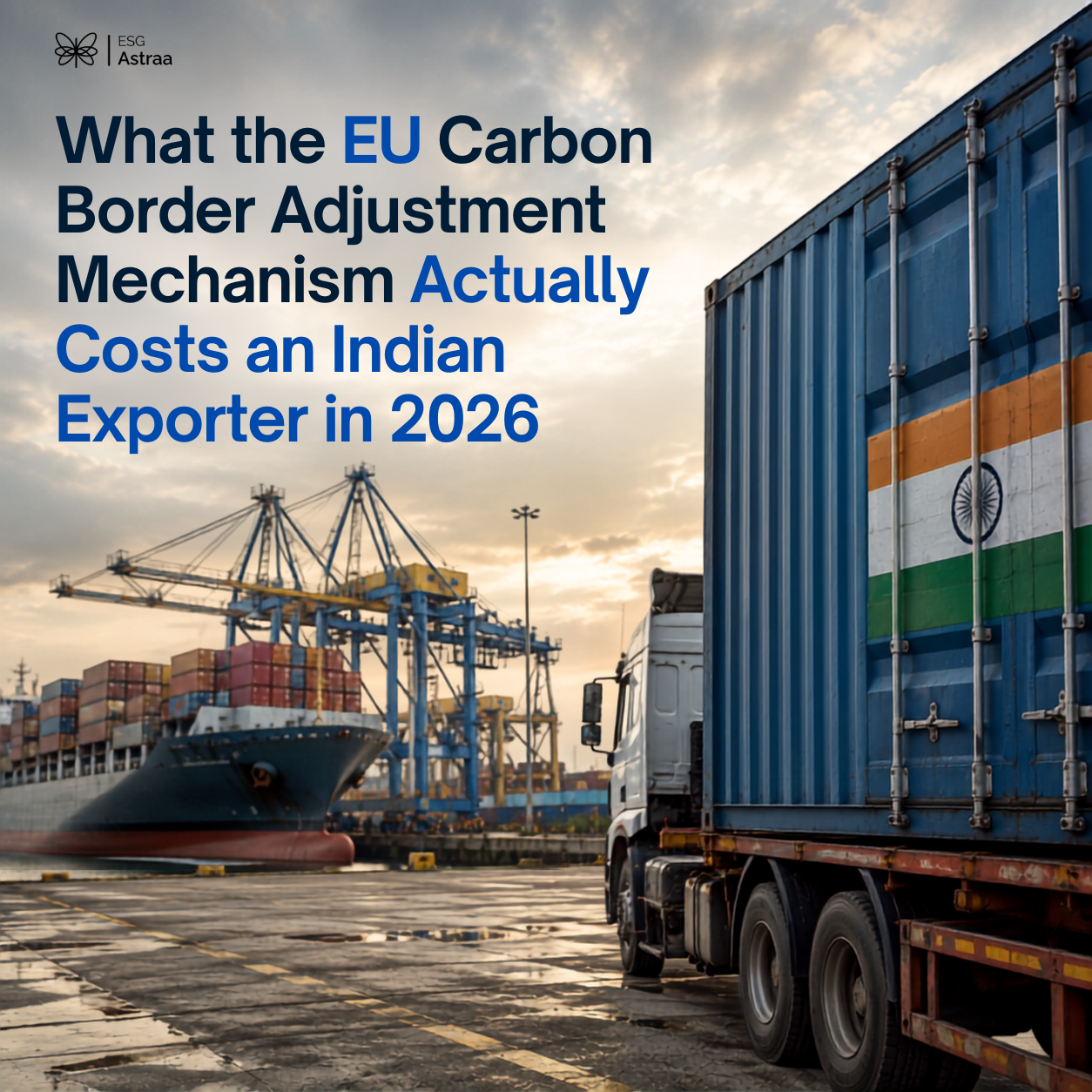
What the EU Carbon Border Adjustment Mechanism Actually Costs an Indian Exporter in 2026
CBAM's definitive phase began on January 1, 2026. For Indian steel, aluminium, cement, and fertiliser exporters, that means real financial obligations — not just reporting.
Reading Time
9 min
Article Sections
6
Share Links
3
On This Page
Article Section
Introduction
CBAM's transition period of three years of reporting-only obligations from October 2023 to December 2025 is now over. From January 1, 2026, the EU Carbon Border Adjustment Mechanism entered its definitive phase. EU importers of covered goods must now purchase CBAM certificates priced at the EU Emissions Trading System auction clearing price and surrender them against verified embedded emissions in the products they import. The obligation is on the EU importer but the financial consequence is already reaching Indian exporters.
India is among the most exposed non-EU countries. Iron and steel account for approximately 90% of India's CBAM-covered exports to the EU, with aluminium, cement, and fertilisers making up the remainder. India's blast furnace-dominated steel production is structurally more carbon-intensive than EU electric arc furnace production and India currently has no domestic carbon pricing mechanism that the EU recognises for CBAM offset purposes.
This piece explains precisely how CBAM works, how the financial obligation is calculated, and what Indian exporters must do to manage their exposure in 2026.
Article Section
How CBAM Works and What It Covers
CBAM is established under Regulation (EU) 2023/956 of the European Parliament and of the Council, dated May 10, 2023, as part of the EU's Fit for 55 legislative package. It covers six sectors: cement, iron and steel, aluminium, fertilisers, electricity, and hydrogen; selected for their carbon intensity and their exposure to carbon leakage risk under the EU ETS.
The mechanism works as follows. EU importers must register as authorised CBAM declarants with their national competent authority. For 2026 imports, the registration deadline was March 31, 2026 under the Omnibus simplification regulation. Authorised declarants must declare the embedded emissions in all covered goods imported during the calendar year and purchase CBAM certificates to cover those emissions. Certificate prices are linked to the EU ETS: for 2026, the price equals the quarterly average of EU ETS auction clearing prices, which have been in the range of 87 to 90 euros per tonne of CO2 equivalent.
Regulation (EU) 2025/2083, the Omnibus amendment, introduced a significant simplification: importers whose cumulative annual CBAM imports fall below 50 tonnes per calendar year are exempt from certificate obligations. This de minimis threshold exempts a large number of smaller importers but does not affect the bulk commodity exporters like Indian steel mills, aluminium smelters, and fertiliser producers whose EU buyers consistently exceed this threshold.
The critical asymmetry for Indian exporters is the absence of a recognised domestic carbon price. Under Article 9 of the CBAM Regulation, importers can deduct carbon costs already paid in the country of production from their CBAM certificate obligation but only if that country operates a carbon pricing system recognised by the European Commission. India's Carbon Credit Trading Scheme, established under the Energy Conservation (Amendment) Act 2022, is nascent and not yet recognised for this purpose. Every tonne of CO2 embedded in Indian exports to the EU currently carries the full certificate cost with no offset.
The European Commission has also proposed extending CBAM to approximately 180 downstream steel- and aluminium-intensive products from January 1, 2028 including pipes, wires, screws, and structural components. This would significantly expand the range of Indian engineering and fabricated metal exports affected.
Article Section
What It Actually Costs: The Mechanics of the Financial Obligation
Step 1: Embedded emissions determine the certificate obligation
CBAM applies to embedded emissions like the direct and indirect greenhouse gas emissions generated in producing the imported good, calculated at the installation level. Embedded emissions equal total process emissions divided by total product output, expressed as tonnes of CO2 equivalent per tonne of product. For steel produced via the blast furnace and basic oxygen furnace route, embedded emissions are structurally higher than for electric arc furnace steel, which is the primary production route in the EU and increasingly in other competing export nations.
Step 2: Actual versus default emission values
EU importers can use either actual verified emissions provided by the Indian manufacturer or EU-established default values. Default values are set at a punitive level, representing the worst 10% of EU ETS producers for each product and country of origin combination. Under implementing acts published by the European Commission on December 16, 2025, default values will increase by 10% in 2026, 20% in 2027, and 30% from 2028 onwards. The financial consequence of relying on defaults rather than actual verified emissions is material and worsens each year. Third-party verification of actual emissions data is mandatory from 2026 for actual values to be accepted.
Step 3: The payment timeline for 2026
CBAM certificates for 2026 imports are not purchased during 2026, they are purchased retroactively. The EU's central CBAM platform opens for certificate sales on February 1, 2027. The first annual CBAM declaration and the corresponding certificate surrender deadline is September 30, 2027. From 2027 imports onwards, authorised declarants must also hold certificates covering at least 50% of year-to-date embedded emissions at the end of each calendar quarter.
Step 4: How the cost reaches Indian exporters
CBAM is legally imposed on EU importers, not on Indian exporters. But the commercial pass-through is already under way. EU buyers are renegotiating contracts to reflect anticipated certificate costs like requesting price reductions, demanding verified emissions data as a procurement condition, or shifting volume toward suppliers from countries with recognised carbon pricing systems. At current EU ETS prices of approximately 87 to 90 euros per tonne and Indian blast furnace steel embedded emissions of roughly 2.0 to 2.5 tonnes of CO2 per tonne of steel, the indicative CBAM cost per tonne of steel exported is in the range of 174 to 225 euros; a figure that is commercially significant against typical steel export margins.
Article Section
What Indian Exporters Need to Do Now?
Determine your CBAM exposure precisely
Identify which products by Combined Nomenclature code fall within CBAM's covered categories, confirm that your EU buyer's annual imports exceed the 50-tonne de minimis threshold, and calculate estimated embedded emissions at installation level. Many Indian exporters have not completed this mapping and are not yet certain of the certificate volumes they will need to support.
Build verified actual emissions data, do not rely on defaults
The cost difference between actual verified emissions and EU default values is a direct financial lever. For a steel exporter with emissions below the default benchmark, third-party verified plant-specific data produces a lower certificate obligation. Accredited verification of actual embedded emissions is the single most effective CBAM cost-reduction measure available to Indian exporters, and the value of that verification increases each year as default penalties rise.
Engage your EU buyers now on contract terms
EU buyers are the legal declarants and certificate purchasers under CBAM but they are already using this obligation as a basis for price renegotiation. Indian exporters who proactively provide verified emissions data, engage on the CBAM cost mechanics, and demonstrate understanding of the framework are in a stronger negotiating position than those who wait for the buyer to initiate.
Prepare for the 2027 financial obligation now
The certificate purchase window opens February 1, 2027 and the surrender deadline is September 30, 2027, but the underlying emissions data must be collected at installation level throughout 2026. Companies that begin building their emissions measurement and data governance infrastructure now will be able to support their EU buyers' CBAM declarations with actual verified values. Those that do not will default to punitive default values.
Reassess EU market strategy for affected product lines
For some production routes and product lines, CBAM costs may erode export margins to the EU to a point where market economics change materially. Diversification of export destinations that carries no CBAM exposure and is a structural option that some Indian steel and aluminium exporters are already pursuing. This is a strategic decision that requires honest modelling of post-CBAM EU margins against alternative market returns.
Article Section
Conclusion
CBAM is not a future risk for Indian exporters but it is a present financial obligation for 2026 imports with a payment deadline of September 30, 2027. The certificate cost is real, the pass-through to export pricing is already happening, and the default value penalties are rising annually through 2028. The exporters that manage CBAM cost effectively are those that treat embedded emissions data as financial data: structured, measured at installation level, verified by an accredited third party, and available to EU buyers when declarations are filed.
The window to build that data infrastructure is 2026, before the first declaration deadline arrives. ESG Astraa works with Indian manufacturers and exporters to assess CBAM exposure, build installation-level emissions measurement frameworks, and prepare the verified data that EU buyers and CBAM declarations will require.
Article Section
Frequently Asked Questions
What is CBAM and which Indian exports does it cover?
CBAM, the EU Carbon Border Adjustment Mechanism is established under Regulation (EU) 2023/956 and requires EU importers to purchase carbon certificates for emissions embedded in imported goods from six sectors: cement, iron and steel, aluminium, fertilisers, electricity, and hydrogen. India's most exposed exports are iron and steel, which account for approximately 90% of India's CBAM-covered trade with the EU.
How is the CBAM certificate price calculated?
For 2026, CBAM certificate prices equal the quarterly average of EU Emissions Trading System auction clearing prices, currently in the range of 87 to 90 euros per tonne of CO2 equivalent. From 2027 onwards, the calculation shifts to weekly EU ETS auction averages. Certificates must be purchased retroactively. The platform opens February 1, 2027 for 2026 imports.
Why can Indian exporters not offset CBAM costs the way some other exporters can?
Under Article 9 of the CBAM Regulation, importers can deduct carbon costs already paid in the country of production — but only if that country operates a carbon pricing system recognised by the European Commission. India's Carbon Credit Trading Scheme is nascent and not yet recognised for this purpose, meaning Indian exporters currently receive no CBAM offset for any domestic carbon action.
What is the difference between actual emissions and default values under CBAM?
Actual emissions are installation-level embedded emissions verified by an accredited third party and provided to the EU importer by the Indian manufacturer. Default values are set by the European Commission at the worst 10% of EU ETS producers and increase by 10% in 2026, 20% in 2027, and 30% from 2028. Exporters with emissions below the default benchmark pay materially less by using verified actual values.
When do Indian exporters need to pay for CBAM certificates?
CBAM certificates for 2026 imports are not paid during 2026. The EU's central CBAM platform opens for certificate purchases on February 1, 2027. The first annual declaration covering all 2026 imports and the corresponding certificate surrender deadline is September 30, 2027. From 2027 imports onwards, quarterly minimum certificate holding requirements also apply.
Keep Reading
Related Blogs
All Industries
ESG and the Indian SME
Why Small Suppliers Are Suddenly Under Pressure From Their Largest Clients
Read more
All Industries
Five ESG Metrics Every Investor Pitch in India Should Now Include
Most Still Don't Know
Read more
All Industries
Carbon Credits vs Carbon Offsets
Understanding the Difference Before Making Climate Claims
Read moreNext Step
Ready to turn ESG complexity into strategic advantage?
Talk to ESG Astraa about disclosures, climate strategy, governance controls, and execution support for your team.