When the Central Bank Joins the ESG Conversation:
RBI's Climate Risk Disclosure Framework Changes the Rules of Corporate Borrowing
Reading Time
5 min
Article Sections
5
Share Links
3
On This Page
Article Section
What Just Happened
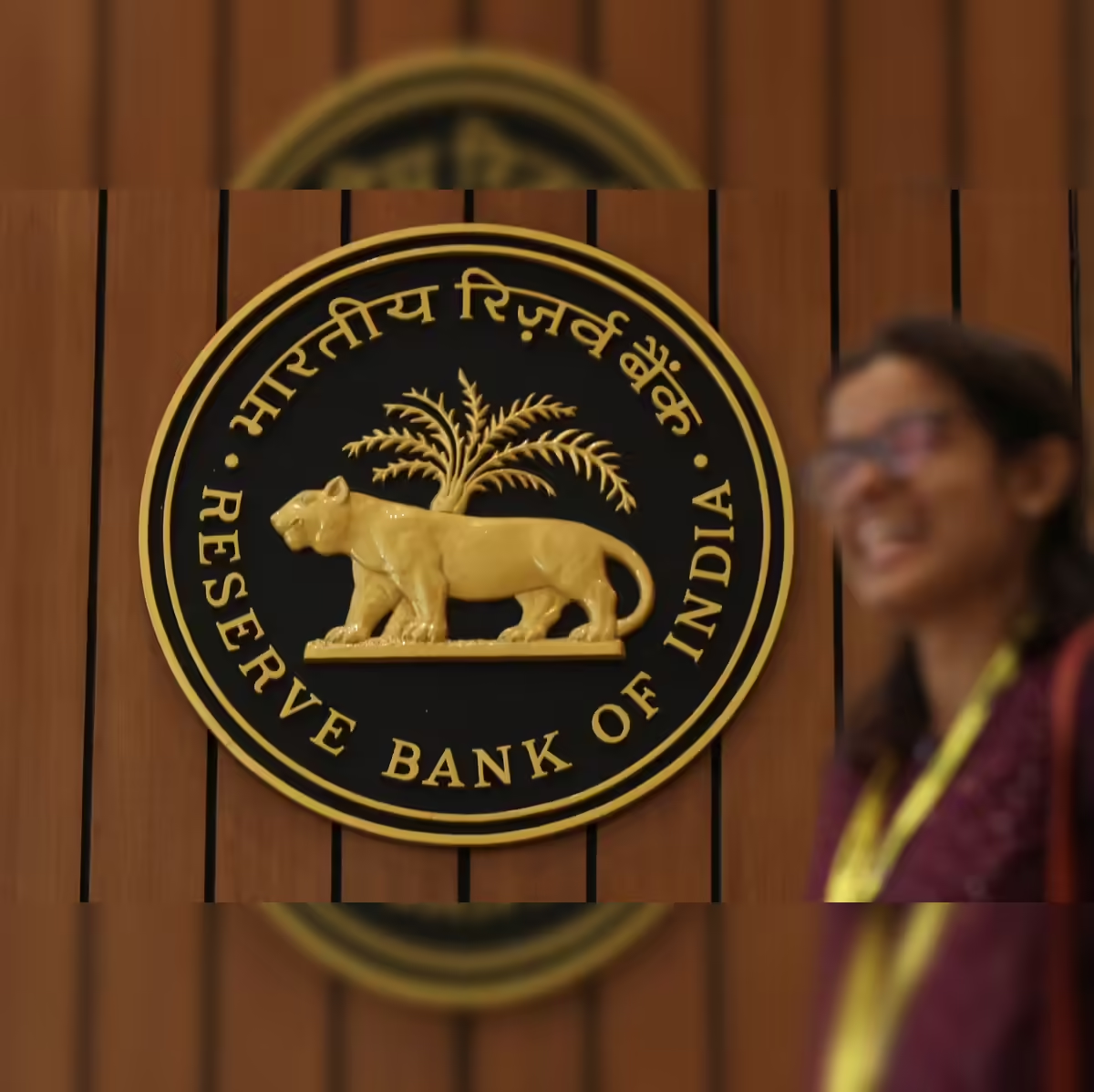
The Reserve Bank of India has issued its Disclosure Framework on Climate-Related Financial Risks, establishing mandatory requirements for regulated entities — including all commercial banks, All India Financial Institutions, and upper and middle layer Non-Banking Financial Companies — to disclose their climate-related financial risks in a structured, standardised format.
The framework applies to commercial banks, financial institutions, and large financial companies from FY 2025–26 onwards, with large cooperative banks following a year later. The disclosures are required to be published as part of banks' financial results and made available online. The RBI has simultaneously formalised its guidelines for green deposits under the RBI (Commercial Banks — Climate Finance and Management of Climate Change Risks) Directions, 2025, requiring banks that raise green deposits to establish Board-approved financing frameworks, deploy proceeds into verified eligible green projects, and submit to third-party assurance and annual impact assessments.
This is not a voluntary reporting exercise. It is a formal regulatory directive from a constitutional authority responsible for the stability of India's financial system, structured around four pillars — governance, strategy, risk management, and metrics and targets — with phased implementation timelines extending through FY 2027–28.
Reference Notes
Sources and standards cited
- 1Reserve Bank of India. Disclosure Framework on Climate-Related Financial Risks. rbi.org.in
- 2RBI (Commercial Banks — Climate Finance and Management of Climate Change Risks) Directions, 2025. taxguru.in
- 3Business Standard. "Reserve Bank Announces Guidelines on Climate Risk, Sustainable Finance." December 2025. business-standard.com
Article Section
Understanding the RBI Climate Risk Framework
Before examining what this means for businesses, it is important to understand what the RBI framework actually requires and why it represents a structural change in how climate risk is managed in Indian finance.
The framework is structured around four disclosure areas that together build a comprehensive picture of how a financial institution identifies, manages, and mitigates climate-related financial risk.
The framework also requires banks to detail their use of scenario analysis and climate stress testing — tools borrowed from macroprudential regulation and now being applied to the specific challenge of climate-driven financial instability. Commercial banks and large NBFCs must begin disclosing governance, strategy, and risk management information from FY 2025–26, with metrics and targets disclosures following from FY 2027–28. The phased structure acknowledges the capacity building required, but the direction is unambiguous and the timeline is now active.
Environmental
- Physical & transition climate risk in loan books
- Emissions data of borrowers in carbon-intensive sectors
- Green deposit allocation to verified climate projects
Social
- Impact of climate events on communities served
- Just transition exposure in bank-financed portfolios
- Financial inclusion in climate-vulnerable geographies
Governance
- Board oversight of climate risk strategy
- Risk management processes for climate scenarios
- Metrics & targets on climate exposure and progress
Reference Notes
Sources and standards cited
- 1Reserve Bank of India. Disclosure Framework on Climate-Related Financial Risks. rbi.org.in
- 2RBI (Commercial Banks — Climate Finance and Management of Climate Change Risks) Directions, 2025. taxguru.in
- 3Business Standard. "Reserve Bank Announces Guidelines on Climate Risk, Sustainable Finance." December 2025. business-standard.com
Article Section
Why This Is a Significant Shift
To appreciate the magnitude of this development, consider what the RBI's entry into climate risk regulation represents structurally. SEBI's BRSR framework, and the CAG's integration of ESG into government audits, operate in the realm of disclosure and accountability. They create transparency obligations and audit consequences. The RBI operates in a different and more direct domain — it governs the institutions through which Indian businesses access capital.
When a regulator like SEBI mandates ESG disclosure, the consequence for a non-compliant company is reputational and regulatory. When the RBI mandates that banks assess and disclose climate risk in their lending books, the consequence flows directly into credit relationships. Banks preparing their own climate risk disclosures will need data from their borrowers. Transition risk assessments — evaluating how exposed a borrower is to policy-driven shifts away from carbon-intensive activities — require understanding a company's emissions trajectory, its energy mix, and its exposure to sectors facing regulatory transition. Physical risk assessments require understanding where a company's assets are located and what weather-related disruptions they face.
This creates a new and consequential data demand that moves from regulator to bank to borrower. Companies that borrow from Indian banks can expect climate-related questions in credit reviews to intensify through 2026 and beyond. Transition plans, physical risk exposure, and Scope 1 and Scope 2 emissions data are beginning to appear in loan documentation. The gap between companies that have this data infrastructure and those that do not will translate directly into differences in the ease, cost, and terms of borrowing.
Furthermore, the RBI's framework explicitly acknowledges that climate-related disclosure practices can help climate-friendly businesses borrow capital at lower rates than carbon-intensive businesses, as climate risk is priced into loans. This is not a distant aspiration — it is an explicit objective of the regulatory architecture now being built.
Reference Notes
Sources and standards cited
- 1Reserve Bank of India. Disclosure Framework on Climate-Related Financial Risks. rbi.org.in
- 2RBI (Commercial Banks — Climate Finance and Management of Climate Change Risks) Directions, 2025. taxguru.in
- 3Business Standard. "Reserve Bank Announces Guidelines on Climate Risk, Sustainable Finance." December 2025. business-standard.com
Article Section
What Businesses Should Watch For
Whether you are a large listed company with significant bank relationships, an NBFC borrower, or a mid-sized business relying on working capital credit, this development has immediate and practical implications. Organisations should be paying attention to the following:
Reference Notes
Sources and standards cited
- 1Reserve Bank of India. Disclosure Framework on Climate-Related Financial Risks. rbi.org.in
- 2RBI (Commercial Banks — Climate Finance and Management of Climate Change Risks) Directions, 2025. taxguru.in
- 3Business Standard. "Reserve Bank Announces Guidelines on Climate Risk, Sustainable Finance." December 2025. business-standard.com
Article Section
The Bigger Picture
This development does not exist in isolation. It is part of an accelerating alignment between India's financial regulatory architecture and its climate commitments. The Securities and Exchange Board of India has expanded the BRSR mandate and introduced assurance requirements. The CAG has embedded ESG into government audits. The Indian Carbon Market has activated a binding price on emissions across industrial sectors. And now the RBI has formally entered the picture, embedding climate risk into the institutional framework that governs India's banks.
Once implemented, India will join countries such as the United Kingdom, the European Union, and Australia that already mandate climate-related financial disclosures from their regulated financial institutions. This positions Indian businesses not only for domestic compliance, but for the scrutiny that comes from operating within a financial system increasingly aligned with global climate standards.
For businesses, the direction is increasingly clear. ESG is no longer a parallel track running alongside the financial system. It is becoming embedded within it. Organisations that build the climate data, transition strategies, and ESG governance structures to engage credibly with their banks, auditors, and regulators will be far better positioned than those who treat each new framework as an isolated compliance event.
The question is no longer whether your climate exposure will enter your banking relationship. The question is whether you will be the one who frames that conversation — or the one who is surprised by it.
Reference Notes
Sources and standards cited
- 1Reserve Bank of India. Disclosure Framework on Climate-Related Financial Risks. rbi.org.in
- 2RBI (Commercial Banks — Climate Finance and Management of Climate Change Risks) Directions, 2025. taxguru.in
- 3Business Standard. "Reserve Bank Announces Guidelines on Climate Risk, Sustainable Finance." December 2025. business-standard.com
Next Step
Ready to turn ESG complexity into strategic advantage?
Talk to ESG Astraa about disclosures, climate strategy, governance controls, and execution support for your team.